

LBS Alumni Spotlight: Vienna to Texas. Classroom to Boardroom.
Meet Roman Namdar, LBS Class of 2020 → now Manager, Credit Risk Services at Lennox International.

Meet Roman Namdar, LBS Class of 2020 → now Manager, Credit Risk Services at Lennox International.

Lauder Business School is proud to announce a major cooperation with leading American university Westcliff University, resulting in an exclusive Second-Degree opportunity available across all Lauder programs.

On December 4th, LBS welcomed Wolfgang Platz founder of Tricentis & Katharo Ventures for an unforgettable Fireplace Talk.

Last week, Lauder Business School hosted Dr. Lóránd Balázs for the November Fireplace Talk. He offered an in-depth look at his professional journey, leadership philosophy, and the rworld of autonomous mobility.
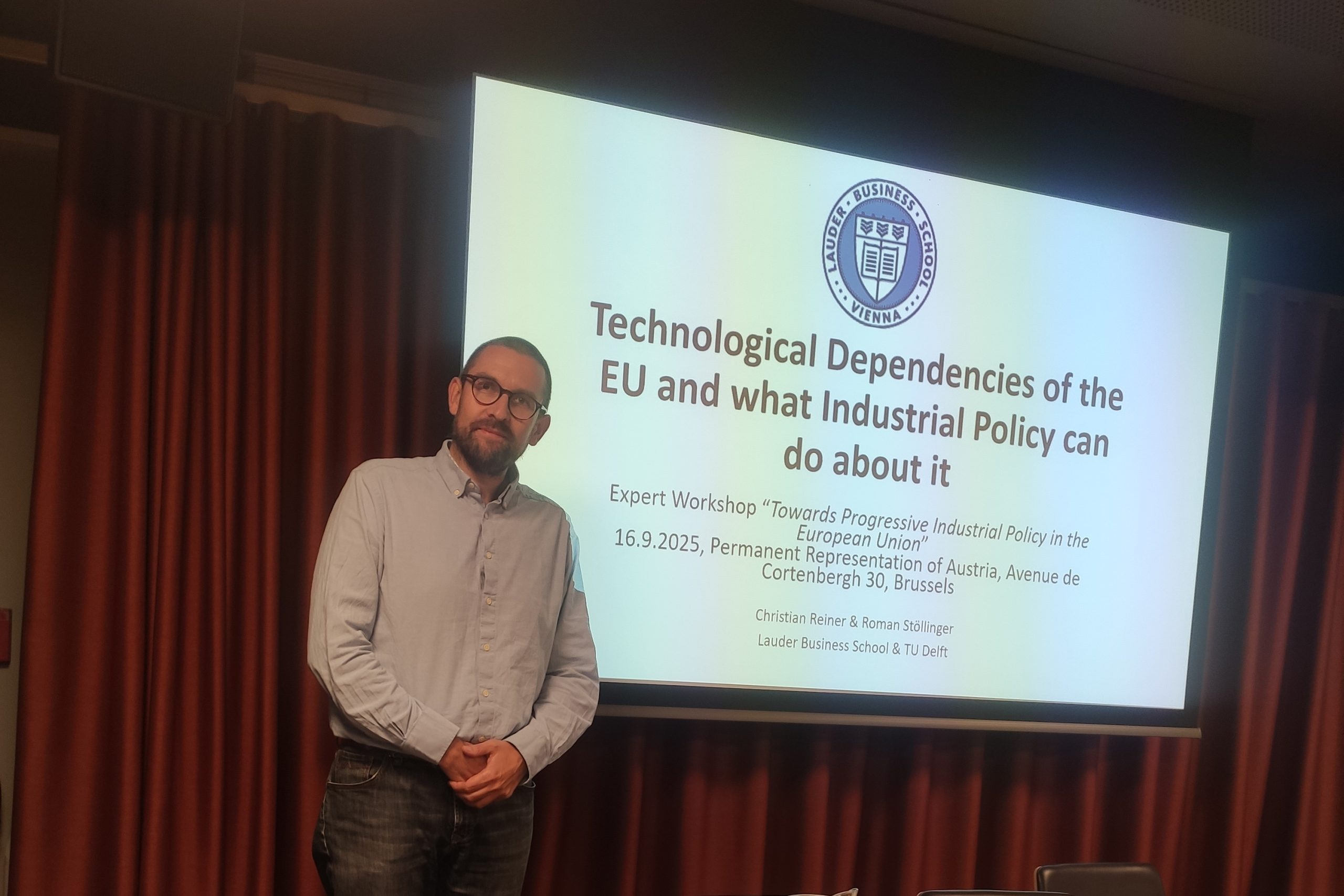
On 15–16 September 2025, Prof. (FH) Dr. Christian Reiner, Senior Lecturer & Head of Research at LBS, participated in a policy event in Brussels that gathered academics, policymakers, and practitioners.
After earning our official ACBSP accreditation on July 1, 2023, Lauder Business School is once again raising the bar. We’re proud to announce our membership in the AACSB Business Education Alliance — one of the most prestigious global networks in business education.

Address: Hofzeile 18-20, 1190 Vienna
Email: [email protected]
Admissions: [email protected]
Phone:+43 1 369 1818
Academic Coordination
Monday through Thursday:
9.00 – 15.00
Resident Permit Services:
Monday, Tuesday, Thursday:
9.30 – 17.00
Friday:
9.30 – 13.30
About Admission
Preparation for the 2nd semester Math Course.
Upon completion of this course, the students will:
Upon completion of this course, the students are expected to:
Upon completion of this course, the students will:
Upon completion of this course, the students will:
Upon completion of this course, the students will:
Upon successful completion of the course:
Upon completion of this course, the students will:
Upon completion of this course, the students will:
Upon completion of this course, the students will:
Upon completion of the course, students are expected to:
Upon completion of this course, the students will:
Upon completion of this course, the students will:
Upon completion of the course, the students are expected to:
Upon completion of this course, the students are expected to:
Upon completion of this course, the students will:
Upon completion of this course, the students are expected to :
Upon completion of this course, the students are expected to:
– Basic usage of Bloomberg to monitor instruments and portfolios
– Understanding the nature of different kinds of securities, how they work and what opportunities and risks they may entail
– Be able to advise customers in a way appropriate to the investment and investor involved keeping in mind aspects of business policy and compliance
– Know the different key figures, documents and ratios of shares / bonds / funds and how they are interpreted during the valuation process
– Know where and how instruments are traded / choosing the right place and “best execution”
– Understand how the sale of various security products affects bank business.
– Being aware of the strong linkage between economic figures and the selection process of shares / bonds
Upon completion of this course, the students will:
– Have an in-depth understanding of Markowitz Portfolio Theory, CAPM, Efficient Markets;
– Have an in-depth understanding of the limitations and empirical testability of these theories;
– Realize potential anomalies arising in financial markets;
– Apply common forecasting models.
Upon completion of this course, the students will:
The course addresses the following topics and questions:
Upon completion of this course, the students will:
Upon completion of this course, the students are expected to:
Upon completion of this course, the students will:
Upon completion of this course, the students will:
Upon completion of this course, the students will:
By the end of this lecture, the theoretical basis is freshed up for planning, controlling and closing the consulting projects, and learning via applied project management enabled.
Also, advanced topics such as “the design of PM processes, project risk & project crisis management, the project-oriented organisation” have been studied.
Upon completion of the course, the students are expected to:
Upon completion of this course, the students are expected to:
Upon completion of this course, the students are expected to:
Upon completion of this course, the students will:
Upon completion of this course, the students will:
Upon completion of the course students will be able to:
Upon completion of this course, the students will:
Upon completion of the course, the students are expected to:
Upon completion of this course, the students will:
By the end of the course students will have achieved the following:
Upon completion of this course, the students are expected to:
Upon completion of the course, the students are expected to:
Upon completion of this course, the students are expected to:
Upon completion of this course, the students are expected to:
Upon completion of this course, the students are expected to:
• understand the time value of money concept.
• perform financial calculations.
• apply methods used to evaluate investments.
• determine an organization’s cost of equity and its cost of debt.
• determine the weighted average cost of capital for an organization, whether it is in the public or private sector, and know how to use it in an investment appraisal.
• analyze and value capital market instruments (e.g. shares and bonds)
• explain and apply the three main methods of company valuation – asset (book) value, market multiples and discounted cash flow.
• appreciate the merits and disadvantages of each technique.
• decide on the most appropriate method or methods of valuation according to the circumstances – regulation, new issues, privatization, merger and acquisition or restructuring.
• classify M&A transactions.
• plan and manage the liquidity of a firm.
Upon completion of this course, the students will:
Upon completion of this course, the students will understand:
• why fallacies make arguments deceptive
• different types of fallacies
• the differences between deductive and inductive reasoning
• the forms and standards of inductive and deductive thinking
• that debate provides preparation for effective participation in a democratic society
• that debate offers preparation for leadership
• that debate offers training in argumentation
• that debate provides for investigation and analysis of significant contemporary problems
• that debate develops proficiency in critical thinking
• that debate is an integrator of knowledge
• that debate develops proficiency in purposeful inquiry
• that debate develops the ability to make prompt, analytical responses
• that debate develops critical listening
• that debate develops proficiency in writing
• that debate encourages mature judgment
• that debate develops courage
• that debate encourages effective speech composition and delivery
• that debate develops social maturity
will have had practice in developing these skills:
• evaluating and critiquing arguments using standards of argument construction, identification of fallacies, tests of reasoning and source credibility
• producing arguments that adhere to the standards of argument construction and avoidance of fallacies
• researching and preparing an argumentative assignment
• researching, selecting and developing appropriate background and supporting materials to support arguments with the consideration for the audience
• expressing ideas skillfully with respect and sensitivity for their audience
• delivering speeches from a limited set of notes and within a specified time frame
• engaging in civil dialogue to define and explain socially significant topics
Upon completion of this course, the students will:
Upon completion of the course, the students are expected to:
Upon completion of this course, the students are expected to:
Python
Pandas Operations
Structured Query Language (SQL)
Upon completion of this course, the students will:
Upon completion of the course, the students are expected to:
Upon completion of this course, students will be able to:
• understand the theoretical foundations of research
• distinguish different research designs, research approaches, research methods and research instruments
• identify a research topic, frame and structure the research problem, determine the research design, select adequate means of measurement and plan for data collection
• design research practicalities from problem formulation to choosing a suitable methodology and drawing conclusions
• relate and apply the theoretical foundations learned in class to their own research project
Upon completion of this course, the students will:
Upon completion of this course, the students will:
Upon completion of this course, the students will:
Upon completion of the course, the students are expected to:
Part I – Introduction
• Explain the rationale for doing valuation
• Address issues of bias, complexity, and uncertainty
Part II – Intrinsic Valuation
• Establish the foundations of intrinsic valuation
• Differentiate between valuing a business and valuing the equity in a business
• Calculate the risk-free rate
• Utilize approaches for estimating equity risk premiums
• Apply approaches for estimating beta values
• Define debt and derive the cost of debt
• Estimate and adjust cash flows
• Determine growth and derive a terminal value
• Understand the purpose and specifications of an LBO model compared to DCF
PART III – Practical Valuation Example
• Calculate a valuation by applying the cost of capital approach and adjusted present value approach
Part IV – Relative Valuation
• Value using multiples
• Identify determinants of ratios
• Choose a peer group and suitable multiples
• Differentiate trading versus transaction multiples
Part V – Asset Based Valuation (optional)
• Calculate liquidation value
• Compare book value versus business value
Upon completion of this course, the students will:
Upon completion of this course, the students will:
Upon completion of this course, the students will:
Upon completion of this course, the students will be able to:
Upon completion of this course, the students will:
Upon completion of this course, the students are expected to:
Upon completion of this course, the students will:
Upon completion of this course, the students are expected to:
Upon completion of the course, the students are expected to:
Upon completion of this course, the students will:
Upon successful completion of this course, students will be able to:
• Understand the major elements of competitiveness
• Understand and analyze the role of clusters for wealth creation
• Understand and analyze determinants of productivity at firm, region and national level
• Conduct a study and evaluate the microeconomics of strategy and economic development of a certain region / cluster.
Upon completion of the course, the students are expected to:
Upon completion of this course, the students will:
Upon completion of the course, the students are expected to:
Upon completion of this course, students should be able to:
Upon completion of this course, the students will:
Upon completion of this course, the students will be able to:
• Describe and apply lean product development approaches (“Job to be done”, ICE, …).
• Design and adapt product ideas to meet customer expectations (experiments, A/B testing, …).
• Use tools (landing pages, ads, …) to test and evaluate ideas and concepts quickly and efficiently.
• Use techniques (interviews, cohorts, …) to develop personas and find a target audience.
• Recognize how to cross the chasm from niche marketing to mass adoption.
• Write extraordinary stories that resonate with customers.
• Use the sheer endless choice of channels to share those stories.
• Define, measure, run and validate social media advertisements, including paid ads, public relations and modern growth hacks.
• Interpret and assess the outcome of past marketing efforts
Upon completion of this course, the students will:
Upon completion of the course, the students are expected to:
• Grasp the following concepts on both theoretical and experiential levels: observing, sensing, perceiving, thinking, labeling, describing, defining, interpreting, facts, inferences, and generalizations.
• Understand the potential for maintaining self-awareness within one’s own thinking-feeling-perceiving-inference-making process.
• Recognize the correlation between clear thinking and maintaining active awareness of the present.
• Understand how clear thinking is connected to word clarity.
• Acquire an understanding of concepts related to assumptions, opinions, viewpoints, and their complexities.
• Comprehend the distinction between mental experiences and problematic confusion with facts.
• Understand how viewpoint bias influences information framing and shaping.
• Grasp the concept of conscious and unconscious viewpoints.
• Understand the nature of arguments as supported claims and differentiate reasons from conclusions.
• Learn analytical techniques for assessing arguments and identifying fallacies.
• Recognize and evaluate seventeen informal fallacies through definitions and examples.
• Gain insight into the forms and standards of inductive and deductive thinking.
• Understand empirical reasoning, the scientific method, hypothesis, probability, and causal reasoning.
• Comprehend the differences between deductive and inductive reasoning and their interaction.
Additionally, students will practice and develop these skills:
• Suspend thinking to observe and gather data.
• Achieve word clarity.
• Describe evidence without introducing labels and interpretations.
• Distinguish facts from inferences.
• Provide evidence to support generalizations.
• Assess assumptions, opinions, and viewpoints for their strengths and limitations.
• Identify underlying and value assumptions in discourse.
• Differentiate opinions from facts.
• Recognize hidden opinions in evaluative language.
• Identify sources and their viewpoint characteristics.
• Analyze news frames.
• Assess source reliability.
• Recognize propaganda characteristics.
• Identify conclusions and reasons within arguments.
• Differentiate reports from arguments.
• Articulate the central issue in question.
• Analyze arguments and detect fallacies.
• Evaluate deductive arguments for validity and soundness.
• Identify hidden premises.
• Apply different standards to inductive and deductive reasoning.
• Conduct research and prepare argumentative assignments.
Upon completion of this course, the students will:
The successful student will display:
Upon completion of this course, the students will:
Upon completion of this course, the students will:
Upon completion of the course, the students are expected to:
Upon completion of this course, the students are expected to:
Part I – Introduction (chapter 3)
Part II – Time, Money, and Interest Rates (chapters 4, 5 and 6)
Part III – Valuing Projects and Firms (chapters 7, 8 and 9)
Part IV – Risk and Return (chapters 10, 11 and 12)
Part V – Capital Structure (chapters 14, 15 and 17)
Upon completion of the course, the students are expected to:
Furthermore, students will further incorporate the following abilities:
Upon completion of this course, the students will:
Upon completion of this course, the students are expected to:
Upon completion of this course, the students will:
Upon completion of this course, the students will:
Upon completion of this course, the students will:
Upon completion of this course, the students are expected to:
– Have broad and practical understanding of the asset management industry and its participants,
– Have broad and practical understanding of the foundations of investment selection and management,
– Create a global equity portfolio, which they will need to maintain, update and report upon regularly during their Masters programme at LBS, and then analyze and explain its performance in the fourth semester,
– Be able to research business data and fundamentals, and apply this to analyse the risk and return characteristics of an investment,
Upon completion of this course, the students will:
– Have broad and practical understanding of the asset management industry and theoretical foundations of investment selection and management;
– Create and analyze a small portfolio of investments;
– Be able to apply factual knowledge, analyze the risk and return characteristics of investment and derive a judgment for evaluating different asset classes;
– Establish a general understanding of the asset management industry and its participants;
– Raise awareness for the key topics shaping the industry in the current environment.
Upon completion of this course, the students will:
– Analyze the professional opportunities in the field of Social Media;
-Decide which channels to choose;
-Set up and advertise company pages in social networks;
-Create content and campaigns and measure the impact on defined goals;
-Judge professional social media content from the viewpoint of the target “consumer”.
Upon completion of this course, the students will:
Learning Outcomes
By the end of this course, students will
– Have learned to understand the basics and the background of integrated marketing communication in various environments.
– Have analyzed, developed and applied techniques of analyzing companies’ business and market environment in terms of IMC
– Understanding the process of turning a company’s IMC strategy into creative, effective, efficient actions and results
– Preparing a company’s internal organization to successfully perform integrated marketing communication
– Understanding the entire interplay of marketing, brand, PR, sales, (social) media, CRM strategies
Learning Outcomes
By the end of this course students will be able to
– sharpen language into an effective tool
– understand the importance of network analysis and networked communication
– take into account the importance of negotiation preparation
– apply the principles of negotiation psychology
– understand the difference between strategy and tactics
– identify and utilize roles in negotiations
– distinguish between different personality types and apply negotiation tactics accordingly
– negotiate in different settings
– realize their own strengths and weaknesses in negotiations
Learning outcomes
The aim of Business German III, IV and V is to develop students’ understanding of the key concepts and principles necessary to achieve level B2 as outlined by the Common European Framework of Reference for Languages (CEFR) with a clear focus on Business German, so that by the end of the 5th semester, students will be able to:
-understand and talk about business topics such as organizations, advertising, brands, human resources, international markets, leadership, etc.
-understand and write business correspondence for a variety of situations
-understand and make business-related telephone calls in a variety of situations
-take part in business meetings and negotiations
-understand, prepare and give a presentation on a business-related topic
Learning outcomes
The aim of Business German III, IV and V is to develop students’ understanding of the key concepts and principles necessary to achieve level B2 as outlined by the Common European Framework of Reference for Languages (CEFR) with a clear focus on Business German, so that by the end of the 5th semester, students will be able to:
-understand and talk about business topics such as organizations, advertising, brands, human resources, international markets, leadership, etc.
-understand and write business correspondence for a variety of situations
-understand and make business-related telephone calls in a variety of situations
-take part in business meetings and negotiations
-understand, prepare and give a presentation on a business-related topic
Learning outcomes
Upon completion of this course students will be able to
– Know, reproduce and understand the key concepts of ecological economics and green growth
– Apply the concepts to both general and business settings
– Reflect on how to reconcile ecological sustainability and business dynamics
Learning Outcomes
Upon successful completion of this course, the you will be able to:
– Recognize, define, and discuss the terminology, concepts, principles, and theories taught in this cultural psychology
– Identify and apply appropriate terminology, concepts, principles, and theories from the course when analyzing factual situations with cultural psychology
– Develop reasonable solutions to cultural psychology problems using appropriate terminology, concepts, principles, and theories from the course.
– Discuss the relevance and application of the concepts, principles, and theories used in cultural psychology to contemporary events.
– Identify and discuss the interrelationships among the concepts, principles, and theories used in the different areas of cultural psychology.
Learning Outcomes
Upon successful completion of this course students will be able to:
– describe the foundation and topics of HRM
– know, reproduce and apply key concepts and techniques of modern HRM
– explain and develop the different steps of a talent management process
– Analyze different HRM methods and their outcome
Upon completion of this course, the students will:
– Know and be able to apply several tools in order to analyze the operations of companies;
– Have a broad and strategic understanding of operations analytics and management;
– Be able to implement actions based on the analysis;
– Execute business process management and reengineering;
– Understand the role of automatization in business;
– Select and apply and understand the respective implications;
– Prepare descriptive, predictive and prescriptive analyses;
– Conducting segmentation, targeting and positioning (STP) based on data and their interpretation;
– Apply a data-driven marketing mix;
– Use specific analytical methods for retail and wholesale data;
– Make managerial decisions based on data and their respective interpretation;
– Forecasting consumer behavior with useful tools;
– Understand how strategic decisions interact with other functional areas.
Upon completion of this course, the students will:
– Have a good understanding of the various tools/techniques associated with problem/opportunity identification,
– Have an understanding of the current state; the methods required to identify, validate and document this condition as such,
– Identify the future state and to come up with models that the desired outcomes are continuously verified, validated and documented,
– Perform a rudimentary gap analysis and any/all necessary exercises tied to a thorough feasibility study,
– Identify the initial scope and be able to perform continuous revisions based upon the information that is unveiled during one’s assignment,
– Be able to create a stakeholder list, perform a stakeholder analysis, initiate a stakeholder strategy and ensure that stakeholder management is performed in an efficient and effective manner,
– Ensure the elicitation process be performed in a meaningful way; including elicitation approach, planning, scheduling, execution, analysis and as input for the solution exploration phase,
– Be able to efficiently ascertain, demonstrate and document all meaningful solution options,
– Based on the listing of all possible solutions, perform the tools and techniques required to establish a short-list of the most viable solutions,
– Execute an effective decision assessment, evaluation, and selection process;
Learning Outcomes
Upon successful completion of the course students will be able to
– Discuss the role of project financing in a corporate environment
– Explain how tools and techniques utilized in project financing can add value to the firm
– Compare and contrast project financing arrangements
– Discuss the advantages and disadvantages of project financial arrangements
– Analyze the risks involved in project financing
– Evaluate the techniques used to manage the risks associated with project financing arrangements
– Describe practical problems of project financing using specific examples
Learning outcomes
At the end of the B1 Level students will be able to
– understand the main points of clear standard input on familiar matters regularly encountered in work, school, leisure, etc.
– deal with most situations likely to arise while traveling in an area where the language is spoken.
– produce simple connected text on topics that are familiar or of personal interest.
– describe experiences and events, dreams, hopes and ambitions and briefly give reasons and explanations for opinions and plans.
Reading Skills:
Students are able to understand factual texts on subjects related to their interests that consist mainly of high frequency everyday or job-related language. They can recognize significant points in straightforward newspaper articles on familiar subjects and can understand the description of events, feelings and wishes
Written Skills:
Students at this level can write simple texts on topics which are familiar or of personal interest by linking a series of shorter discrete elements into a linear sequence. They can write personal letters describing events, experiences and impressions.
Oral skills/Speaking and Understanding:
Listening: They are able to understand the main points of clear standard speech on familiar matters regularly encountered in work, school, leisure, etc. They can understand the main point of many radio or TV programmes on current affairs or topics of personal or professional interest when the delivery is relatively slow and clear.
Spoken Production: They can keep going comprehensibly in order to describe experiences and events, dreams, hopes and ambitions and can briefly give reasons and explanations for opinions and plans. They are able to narrate a story or relate the plot of a book or film and describe reactions.
Language skills:
Used to + infinitive • Past Simple and Present Perfect • Neither / so do I • Modal verbs • Reported speech • First, second conditional • Adverbs of manner and modifiers • Relative clauses • Adjectives and their connotations • Present Perfect Continuous • Look + adjective, look like + noun • Be able to/ can/ manage to • Passives • Past Perfect Simple • Have and have got • Be allowed to and be supposed to • A / few and a / little • Although / in spite of / despite • Question tags
Upon completion of this course, the students will:
– Know and be able to apply several tools in order to analyze the operations of companies;
– Have a broad and strategic understanding of operations analytics and management;
– Be able to implement actions based on the analysis;
– Execute business process management and reengineering;
– Understand the role of automatization in business;
– Select and apply and understand the respective implications;
– Prepare descriptive, predictive and prescriptive analyses;
– Conducting segmentation, targeting and positioning (STP) based on data and their interpretation;
– Apply a data-driven marketing mix;
– Use specific analytical methods for retail and wholesale data;
– Make managerial decisions based on data and their respective interpretation;
– Forecasting consumer behavior with useful tools;
– Understand how strategic decisions interact with other functional areas.
Upon completion of this course, the students will:
– Recognize the general concepts of the governance framework of organizations;
– Compare the corporate governance structure regarding organizations in different industries and different regions and comprehend the global dimension of corporate governance;
– Illustrate the significance of risk management principles for good governance;
– Develop a keen awareness of the undesirable consequences of weak corporate governance practices and provide recommendations for mitigations;
– Explain the influence of major constituents on such governance framework within given circumstances;
– Evaluate the relation of performance and governance of an organization;
– Categorize responsibilities of organizations to different stakeholder groups and judge on corporate (social) responsibility;
– Distinguish best-practice and pitfalls based on readings and group work assignments;
– Demonstrate the acquired knowledge and skills in a qualified understanding of reports on corporate governance issues in popular media and participation in professional discussions;
Upon completion of this course, the students will:
– Recognize the general concepts of the governance framework of organizations;
– Compare the corporate governance structure regarding organizations in different industries and different regions and comprehend the global dimension of corporate governance;
– Illustrate the significance of risk management principles for good governance;
– Develop a keen awareness of the undesirable consequences of weak corporate governance practices and provide recommendations for mitigations;
– Explain the influence of major constituents on such governance framework within given circumstances;
– Evaluate the relation of performance and governance of an organization;
– Categorize responsibilities of organizations to different stakeholder groups and judge on corporate (social) responsibility;
– Distinguish best-practice and pitfalls based on readings and group work assignments;
– Demonstrate the acquired knowledge and skills in a qualified understanding of reports on corporate governance issues in popular media and participation in professional discussions; – Know generally accepted practice in the design, development, implementation, maintenance and continual improvement of a compliance program;
– Comprehend the position of a compliance management system in the governance framework of an organization;
– Apply the acquired knowledge to various regulatory requirements;
– Examine and combine the elements of a compliance management system to the extent appropriate to the internal and external context of an organization;
– Evaluate the approach of global corporations to compliance management, determine best practice and pitfalls and the application of this approach to other types of organizations;
– Consolidate all steps in a comparative analysis regarding the compliance approach of organizations in different industries;
– Be attentive to the need of compliant behavior in the conduct of business activities for minimizing the risks of failure and avert harm from the organization;
– Recognize the benefits of knowledge and skills in compliance management for their future career after graduation;
– Adapt the acquired knowledge and skills resulting in a qualified understanding of reports on non-compliant behavior in popular media and the ability to participate in professional discussions.
Upon completion of this course, the students will:
– Have a detailed knowledge of Performance Evaluation and Budgetary Control;
– Be able to apply Variance Analysis as part of the Control Loop in management control;
– Comprehend and be able to apply operational level performance management concepts of Profit Centers, Investment Centers and corresponding measures of performance;
– Comprehend and be able to apply performance-related concepts in Activity-Based Management;
– Be able to use financial statements to evaluate business performance.
Upon completion of this course, the students will:
– Appreciate the value of entrepreneurship and innovation outcomes for economic renewal and rejuvenation in a variety of organizational contexts;
– Understand the process of entrepreneurship and of creating new ventures;
– Have the ability to carry out the preparatory work necessary to develop a business idea, draw up a business plan and present it in front of an audience;
– Have the ability to implement, operate and monitor the execution of this process.
Upon completion of this course, the students will:
– Do extensive research in the specific field;
– Gather and filter the appropriate data for the project;
– Select and apply appropriate the appropriate analytical tools and concepts;
– Interpret and evaluate the results;
– Employ scientific research methods in small- to medium scale quantitative and/or qualitative studies;
– Create strategies in order to resolve business- and economics-related problems;
– Critically reflect upon the takeaways of a project/analysis in light of the limitations;
– Reflect upon the analyses;
– Conduct a major project (project management skills) individually;
– Organize communication processes with numerous stakeholders;
– Present the research project in a focused, professional and convincing manner.
Upon completion of this course, the students will:
– Use skills, frameworks and knowledge in entrepreneurial finance (similarly to traditional corporate finance, yet more focused on cash flow, returns, and recognizable value);
– Recognize an opportunity worthy of financing;
– Value an opportunity;
– Understand the difference between the funder’s perspectives and those of the company being financed;
– Appreciate the difference between venture capital, private equity, early stage, and traditional financing sources;
– Approach a venture capital source and present your idea;
– Use different financing techniques;
– Use strategic partnering.
Upon completion of this course, the students will:
– Be familiar with the basic concepts of operations and supply chain management;
– Be able to describe the key capabilities of a supply chain;
– Apply concepts, conduct analyses and evaluate scenarios in the field of purchasing, inventory management, logistics, planning, forecasting, etc.;
– Have a good understanding of how company strategy impacts its supply chain/operations capabilities;
– Be able to apply operations and supply chain management concepts when analyzing and improving a company or a specific problem.
Upon completion of this course, the students will:
– Have an unbiased picture of one’s skills, personality, and values;
– Recognize how interviewers perceive particular words, meta-communication, and specific behavioral patterns;
– Assess candidates pros and cons;
– Have a good understanding of how particular jobs and candidates might match;
– Develop your career roadmap.
Upon completion of this course, the students will:
– Have a broad and practical knowledge on Statistics-related problems;
– Know, understand and reproduce key concepts of Statistics;
– Demonstrate rationality when interpreting Statistics;
– Analyze datasets in SPSS;
– Conduct statistical tests, basic and intermediate analyses in statistics with SPSS;
– Answer simple statistical questions with ease;
– Understand and recognize the relevance and implications of the misuse of Statistics.
Upon completion of this course, the students will:
– Define and explain Strategic Human Resource Management;
– Compare HRM & SHRM;
– Recognize the advantages and limitations of the different approaches to SHRM;
– Identify and explain the major features of strategic recruitment and selection;
– Analyze how recruitment and selection can be developed to fit a variety of strategic scenarios;
– Understand the place of recruitment and selection as well as the value of testing and work samples;
– Identify and explain the major features of strategic human resource development (SHRD);
– Analyze the significance of the learning organization and knowledge management to SHRD;
– Explore whether training initiatives become more extensive as examples of HR strategies;
– Assess the strategic impact of training and development policies and practices;
– Define performance management and discuss how it differs from performance appraisal;
– Set effective performance appraisal standards;
– Explain and illustrate the problems in order to avoid them in appraising performance;
– Evaluate the major criticisms towards performance management;
– Create and apply a performance appraisal;
– List the basic factors determining pay rates;
– Define reward management and strategic reward management;
– Explain the factors that have led to the increased interest in strategic reward management;
– Identify some of the key background issues relevant to the internationalization of businesses;
– Define strategic international human resource management (SIHRM) and identify its key components;
– Illustrate how intercountry differences affect HRM;
– Discuss the use of Locals vs. Expats;
– Identify important issues in training, appraising and compensating international employees;
– Explain how to implement a global HRM program;
– Discuss how small business HRM is different from large businesses HRM and how small size can improve the SHRM processes.
Upon completion of this course, the students will:
– Receive a Master’s degree (MA) in Strategic Finance and Business Analytics from Lauder Business School.
Upon completion of this course, the students will:
– Recognize, define, and discuss the terminology, concepts, principles, and theories taught in this organizational behavior course;
– Identify and apply appropriate terminology, concepts, principles, and theories from the course when analyzing factual situations with organizational behavior problems;
– Develop reasonable solutions to organizational behavior problems using appropriate terminology, concepts, principles, and theories from the course;
– Evaluate the quality of their proposed solutions to organizational behavior problems against appropriate criteria, including organizational constraints;
– Discuss the relevance and application of the concepts, principles, and theories used in organizational behavior to contemporary events;
– Identify and discuss the interrelationships among the concepts, principles, and theories used in the different areas of organizational behavior.
Upon completion of this course, the students will:
– Recognize, define, and discuss the terminology, concepts, principles, and theories taught in this organizational change course;
– Identify and apply appropriate terminology, concepts, principles, and theories from the course when analyzing situations involving change;
– Develop reasonable solutions to change management problems using appropriate terminology, concepts, principles, and theories from the course;
– Evaluate the quality of their proposed solutions to change management problems against appropriate criteria, including psychological and organizational constraints;
– Discuss the relevance and application of the concepts, principles, and theories used in change management to contemporary business;
– Identify and discuss the interrelationships among the needs of organizations and of their members and other stakeholders in change.
Upon completion of this course, the students will:
– Have a broad and practical knowledge of economics-related problems;
– Know, understand and reproduce key concepts of behavioral economics and decision-making;
– Apply the concepts to both general and business settings;
– Reflect on these concepts and their managerial implications;
– Understand the relevance and the implications of the practical examples and the games, situational tasks they participate in with the lecturer;
– Digest and critically reflect upon scientific articles in the field of behavioral economics;
– Recognize and apply relevant concepts of social psychology to business settings;
– Know and understand biases and the covered behavioral factors, be able to elaborate on their relevance and the exact ways how to overcome them.
Upon completion of this course, the students will:
– Understand the benefits and boundaries of project management;
– Be able to differentiate between processes, projects, and programmes;
– Be able to understand projects as social systems;
– Be able to identify the main project success factors such as context-thinking, business-case thinking, and social competences;
– Be able to apply main project management methods.
Upon completion of this course, the students will:
– Know generally accepted practice in the design, development, implementation, maintenance and continual improvement of a compliance program;
– Comprehend the position of a compliance management system in the governance framework of an organization;
– Apply the acquired knowledge to various regulatory requirements;
– Examine and combine the elements of a compliance management system to the extent appropriate to the internal and external context of an organization;
– Evaluate the approach of global corporations to compliance management, determine best practice and pitfalls and the application of this approach to other types of organizations;
– Consolidate all steps in a comparative analysis regarding the compliance approach of organizations in different industries;
– Be attentive to the need of compliant behavior in the conduct of business activities for minimizing the risks of failure and avert harm from the organization;
– Recognize the benefits of knowledge and skills in compliance management for their future career after graduation;
– Adapt the acquired knowledge and skills resulting in a qualified understanding of reports on non-compliant behavior in popular media and the ability to participate in professional discussions.
Upon completion of this course, the students will:
– Receive a Master’s degree (MA) in International Management and Leadership from Lauder Business School.
Upon completion of this course, the students will:
– Understand what a business model is and how it works;
– Analyze business processes using several models (resources, processes, requirements, etc.);
– Know what can be achieved with effective business intelligence;
– Know how to conduct a business analysis;
– Apply several analytical methods and understand their relevance/caveats at the same time;
– Grasp the importance and the implications of Big Data and Data Mining;
– Visualize data and their interpretation powerfully.
Upon completion of this course, the students will:
– Develop their understanding of the core and current frameworks, theories, and tools and to assess their relevance to the issues of the twenty-first century leading and managing;
– Explain and discuss different perspectives on, and approaches to, managing and leading in different organizational and cultural contexts;
– Critically engage with management frameworks, theories, and tools in order to select and adapt techniques and approaches appropriate to given management contexts;
– Discuss and analyze the context in which business and management takes place, and to develop approaches on how to work confidently across sectoral and national boundaries;
– Develop interpersonal and conceptual skills that will assist in the use of ideas and frameworks to make sense of, and to work with, organizational complexity;
– Challenge their own knowledge, thinking and practice by reflecting upon it critically in the light of the ideas encountered, and through debates with others.
Upon completion of this course, the students will:
– Comprehend fundamental accounting concepts/principles and their importance to financial reporting;
– Acquire a sound knowledge of the several functions of Financial Accounting;
– Have a detailed knowledge of the structure of Financial Statements, i.e. Income Statements, Balance Sheets, Statements of Cash Flows;
– Be able to prepare a set of Financial Statements.
Upon completion of this course, the students will:
– Understand why it is crucial to know your customer (KYC Checks);
– Work out different scenarios on attempted manipulation of capital markets –front/parallel running, crossing, scalping, cornering, wash sales;
– See how services and products changed facing banking regulations (MAD/MAR II, MiFID II, anti-money laundering, etc.);
– Grasp the challenges and instruments of Compliance officers;
– Judge the influence of new technologies – internet currencies;
– Recognize crime and terror financing – anti-money laundering;
Upon completion of this course, the students will:
– Understand the concept of “shadow banking” and the respective regulatory responses;
– Know the practical, contractual and regulatory aspects of securitization;
– Know the practical and regulatory aspects of money market funds;
– Understand the core (regulatory and contractual) principles derivatives and structured finance;
– Be familiar with the European Market Infrastructure Regulation (EMIR) and corresponding regulations in the U.S.
Upon completion of this course, the students will:
– Define business- and economics-related problems of practical relevance individually;
– Do extensive research in the specific field;
– Gather and filter the appropriate data for the project;
– Select and apply appropriate the appropriate analytical tools and concepts;
– Interpret and evaluate the results, – Create strategies in order to resolve business- and economics-related problems;
– Critically reflect upon the takeaways of a project/analysis in light of the limitations;
– Reflect upon the analyses;
– Know what a consultant does;
– Understand the value added of consulting;
– Conduct a major project (project management skills) individually;
– Provide fact-based, critical and constructive feedback on others’ projects;
– Present the research project in a focused, professional and convincing manner.
Upon completion of this course, the students will:
– Demonstrate, grasp and apply explicit and practical knowledge relevant to private banking and wealth management;
– Be prepared for a career in private banking in their respective home countries;
– Understand and apply explicit and practical knowledge relevant to private banking and wealth management;
– Demonstrate the ability to discern client needs and provide suitable financial solutions making use of a range of products (securities, loans, insurances, term deposits) and investment fundamentals (modern portfolio theory);
– Have an overview of the relevant regulatory and tax changes and be able to explain these in an advisory setting;
– Grasp the particularities of the main private banking topics within the context of the countries/regions in which they intend to live and work.
Upon completion of this course, the students will:
– Have a broad and practical knowledge on real estate investment after passing this course;
– Recognize and evaluate the determinants of value: individual property characteristics, market conditions of supply and demand, capital market influences, public policy effects;
– Be familiar with the legal and regulatory environment in various markets: property rights and limitations, leases and other contracts, land use regulations;
– Understand the roles and responsibilities of the “players” in the marketplace;
– Estimate the value of income-producing properties;
– Understand sources of capital and the basics workings of the real estate capital markets;
– Determine a basic capital structure for a property acquisition including the amount, cost, and other market terms for debt;
– Explore societal challenges and opportunities that result from the inherent tension of individual versus communal rights and responsibilities.
Upon completion of this course, the students will:
– Understand what a business model is and how it works;
– Analyze business processes using several models (resources, processes, requirements, etc.);
– Know what can be achieved with effective business intelligence;
– Know how to conduct a business analysis;
– Apply several analytical methods and understand their relevance/caveats at the same time;
– Grasp the importance and implications of Big Data and Data Mining;
– Visualize data and their interpretation powerfully;
Upon completion of this course, the students will:
– Prepare descriptive, predictive and prescriptive analyses;
– Conducting segmentation, targeting and positioning (STP) based on data and their interpretation;
– Apply a data-driven marketing mix;
– Use specific analytical methods for retail and wholesale data;
– Make managerial decisions based on data and their respective interpretation;
– Forecasting consumer behavior with useful tools;
– Understand how strategic decisions interact with other functional areas.
Upon completion of this course, the students will:
– Understand the nature of different types of securities, how they work and what opportunities and risks they may entail;
– Be able to advise customers in a way appropriate to the investment and investor involved, keeping in mind aspects of business policy and compliance;
– Know the different key figures, documents and ratios of shares/bonds/ funds and how they are interpreted during the valuation process;
– Know where and how instruments are traded, choosing the right place and “best execution”;
– Understand how the sale of various security products affects bank business;
– Be aware of the strong linkage between economic figures and the selection process of shares/bonds.
Upon completion of this course, the students will:
– Understand and differentiate between different types of financial institutions as well as their role as intermediaries in the financial market, structures, tasks and business areas;
– Understand and apply essential concepts in the field of financial markets and financial institutions;
– Explain different types of financial markets and basic products;
– Explain the role of financial market participants (e.g. commercial banks, rating agencies, etc.);
– Explain the overall impact of tax and regulatory frameworks for financial institutions in the market.
Upon completion of this course, the students will:
– Understand the business cycle of an open economy in an AS-AD model framework;
– Analyze the current cyclical situation of economies by applying standard macroeconomic models and deriving implications for monetary policy;
– Understand the theory of optimum currency areas;
– Know the history of the European integration process;
– Assess the costs and benefits for countries to join a monetary union as well as the net effect;
– Know various exchange rate regimes;
– Be able to judge countries’ choice of exchange rate regimes and assessment of the sustainability of this choice;
– Understand the goals and effects of monetary policy strategies and of monetary policy instruments;
– Understand the monetary policy challenges during the global financial crisis and the corresponding monetary measures;
– Be able to link various types of crisis and to derive sources of spillovers and/or feedback loops;
– Be able to draw lessons from the experience during the global economic and financial crisis;
– Be able to assess the specific weaknesses and macroeconomic imbalances of EU crisis countries;
– Understand the trade-offs of financial globalization, the financial cycle and the impact on financial stability;
– Understand the interactions between monetary policy and macro-prudential policy.
At the end of the semester students will be able to:
Written skills:
– summarize highly nuanced and sophisticated texts
– produce comparison and contrasts of advanced texts
– plan and structure an argument/investigation drawing on a wide variety of sources
– incorporate summary, paraphrases and quotation effectively in their text
– write a structured and referenced argumentative essay
– critically engage with a wide variety of texts, both academic and literary
– write creatively using a wide range of basic techniques
– write a review article
– write flash fiction/descriptive scene
Oral skills/Speaking and Understanding:
– summarize and react to academic texts
– defend arguments
– use a range of different appeals to convince audiences of an argument
– respect and engage constructively with the opinion of others
Language skills/vocabulary:
– use advanced techniques such as parallelism to increase the emphasis and clarity of their writing
– understand an increased range of specialized and less common vocabulary
– be aware of different styles and their importance
– Consolidation of productive and receptive knowledge of the romanization system Hanyu Pinyin.
– Consolidation of correct pronunciation of the sounds and tones of modern Chinese.
– Independent and creative use of the Chinese language in various situations.
– Consolidation of knowledge of the structure of Chinese characters.
– Handwriting skills of commonly used Chinese characters.
– Reading of texts written in Chinese characters pertaining to various situations.
By the end of the second semester, students will be able to conjugate active verbs (paal,hifil, piell, hitpael) in the present tense, recognize and use simple syntactic structures; read and write shorts texts, few sentences about different topics
This course will lead students to the A1/ 2 level of competence following the Common European Framework of Reference for Languages.
This course will lead students to the, A1 level of competence following the Common European Framework of Reference for Languages.
By the end of the first semester, students will be able to conjugate active verbs in the present tense, recognize and use simple syntactic structures; read and write texts with non-compound sentences.
Learning Outcomes
By the end of the semester students will have acquired the following skills:
Written Skills:
– write simple formal and informal texts
Oral Skills
– discuss a problem
– give advice
– express agreement or disagreement
– describe a picture in detail
– express wishes and hypothetical ideas
Grammar Skills:
– form subordinate clauses with the infinitive
– declinate adjectives
– form the conditional
Students will possess significant knowledge of vocabulary relating to:
– the time
– problems of everyday life
– partnerships and love
– jobs for men vs. jobs for women
– work in the course of time
– schools and education
Learning Outcomes
The goal of the Practical Professional Training (course) is to acquire real work experience in business-framework by applying the acquired theoretical knowledge. The Practical Training will offer students opportunities to additionally acquire practical skills required for entering the labor market as well as experience in: working in companies (e.g. responsibility, working under pressure, acquiring new skills); strengthening the suitability of students’ personal characteristics (e.g. time management, activity planning, evaluation of suitability of job, strengths and weaknesses); strengthening the suitability and level of students’ acquired knowledge (skills related to students’ education – communication, technological skills, etc.; university knowledge). Furthermore, the PPT will offer potentials for students’ future careers (career management skills, creating contacts, networking, etc.).
Learning Outcomes
The course will lead students to the A2.2 level of competence (following the Common European Framework of Reference for Languages).
Learning Outcomes
By the end of Hebrew 5, students will have completed a introduction to the grammar and basic syntactic structures of modern Hebrew. They will also be able to converse on a number of topics and to discuss simple critical ideas.
Learning outcomes A2+:
After successfully completing this course, students will be able:
– to understand newspaper articles and reports on contemporary problems, economic and business issues as well as specialized texts in the own professional field;
– to understand radio and TV reports spoken in standard language;
– to understand complex speeches and lectures in the own professional field;
– to write corporate history, complex business reports, graph descriptions, meeting summaries, information letters, offers, confirmations;
– to communicate easily during stays in Russia, to participate in talks on familiar topics;
– to make complex telephone calls (requests, providing information), to establish business contacts, to make a product or firm presentation, to conduct negotiations, to make contracts.
After successfully completing this course students will have a profound basis to pass the Certification Exam B1 Business Russian and obtain an internationally recognized certificate.
– Consolidation of correct pronunciation of the sounds and tones of modern Chinese.
– Independent and creative use of the Chinese language in various situations
– Consolidation of knowledge of the structure of Chinese characters.
– Handwriting skills of commonly used Chinese characters.
– Reading of texts written in Chinese characters pertaining to various situations.
– Social Business Chinese: intercultural and language competence for business cooperations with China
By the end of this course students will be able to:
– write clear and effective academic texts
– compare opinion effectively from a wide variety of sources
– prepare the sections of a BA thesis
– express their analysis of evidence clearly
– present information
– compare literature
– write an abstract
– write a research proposal
Learning Outcomes
The course will lead students to the A2.1 level of competence (following the Common European Framework of Reference for Languages).
Learning Outcomes
Students will be able to use verbs in the future tense. They will be able to converse on a variety of subjects from everyday life and to share/ describe their ideas. They will be able to read simplified texts.
Learning Outcomes
By the end of this semester students will have acquired the following skills:
Written Skills:
– write an autobiographical text
– write a story in the past tense
– write a variety of communicative documents
– write texts relating to the working environment
Oral skills:
– talk about work experience and career plans
– leave a formal phone message
– talk about festivities and customs
– talk about conditions and consequences
– recognize and express emotions
– formulate goals
– discuss a problem
– give advice
Grammar skills:
– form the conditional
– form the passive voice
– use the dative with verbs and prepositions
– form if clauses
– form relative clauses
– recognize the genitive
Students will possess significant knowledge of vocabulary relating to:
– education, professional training, work
– festivities and traditions
– feelings
– inventions and products
– the time
– problems of everyday life
Learning Outcomes
After successfully completing this course, students will be able:
– to understand newspaper articles and reports on contemporary problems, economic and business issues as well as specialized texts in the own professional field;
– to understand radio and TV reports spoken in standard language;
– to understand complex presentations in the own professional field;
– to write corporate history, complex business reports, graph descriptions, summaries of business talks, information letters, offers, confirmations;
– to communicate easily during stays in Russia, to participate in talks on familiar topics;
– to make complex telephone calls (requests, providing information), to establish business contacts, to make a product or firm presentation, to conduct negotiations, to close contracts.
Learning Outcomes
– Consolidation of correct pronunciation of the sounds and tones of modern Chinese.
– Independent and creative use of the Chinese language in various situations
– Consolidation of knowledge of the structure of Chinese characters.
– Handwriting skills of commonly used Chinese characters.
– Reading of texts written in Chinese characters pertaining to various situations.
Learning Outcomes
This course will lead students to the A2 level of competence following the Common European Framework of Reference for Languages.
Learning Outcomes
Students will be able to use active verbs in the present tense and in the past tense. They will be able to converse on a variety of subjects from everyday life. They will be able to read simplified texts.
Learning Outcomes
By the end of the semester students will have acquired thh following skills:
Written Skills:
– write short texts such as emails, text messages, informal letters, invitations and notes
Oral skills:
– plan and book a trip
– express an assumption
– express emotions
– express positive and negative reactions
– discuss advantages and disadvantages
– express a complaint
– order in a restaurant
– plan an evening (say what you feel like doing)
Grammar skills:
– use reflexive verbs
– use verbs with prepositions
– form embedded questions
– form relative clauses
– form modal verbs in the past tense
– form the past tense
Students will possess significant knowledge of vocabulary relating to:
– traveling and traffic
– hobbies and sports
– media, especially computer and internet
– free time, eating out
– living in the city / in the country
– culture
– relationship
Learning Outcomes
Learning outcomes A2+:
After successfully completing this course, students will be able:
– to understand personal letters which describe feelings, wishes, and events
– to understand diverse text types on familiar topics written in standard language (global and detailed reading)
– to search for specific information in authentic documents, brochures and on websites (selective reading);
– to understand radio and TV reports spoken in standard language;
– to understand presentations in the own professional field;
– to write personal letters expressing his/her own opinion;
– to write business reports, summaries of business talks, information letters, invitations, CV, job descriptions;
– to express oneself in familiar situations, to give one’s opinion, to explain situations;
– to make telephone calls (appointments, requests, providing information), to participate in discussions, to conduct a job interview and answer questions as an job applicant.
Learning Outcomes
– Consolidation of productive and receptive knowledge of the romanization system Hanyu Pinyin.
– Consolidation of correct pronunciation of the sounds and tones of modern Chinese.
– Independent and creative use of the Chinese language in various situations.
– Consolidation of knowledge of the structure of Chinese characters.
– Handwriting skills of commonly used Chinese characters.
– Reading of texts written in Chinese characters pertaining to various situations.
Learning Outcomes
At the end of this Semester students will be able to:
Written skills:
– produce a suite of formal and informal letters and emails
– write structured and developed letter of motivation (cover letter) and CV
– produce Context Action Result (CAR) responses to on-line application form questions
– form developed, unified and coherent paragraphs as blocks in extended pieces of writing
– use advanced techniques to add variety and emphasis to writing
– produce meeting minutes
Oral skills/Speaking and Understanding:
– answer an array of job interview questions
– use an awareness of the importance of body language to increase their effectiveness at job interview
– discuss fluently a wide variety of salient business topics
– communicate in English as a Lingua Franca
– negotiate effectively
Language skills/vocabulary:
– use elegant, non-bureaucratic or non-discriminatory phraseology
– use an extensive range of both formal and informal business terms
– use different tones to convey subtleties of meaning within polite, formal business language
– accurately use all the major punctuation: colons, semi-colons, commas and hyphens
By the end of the semester students will have acquired the following skills:
Written Skills:
– write short texts such as postcards, text messages and short emails
Oral Skills:
– talk about the past
– buy food
– buy clothes
– talk about the weather
– talk to a doctor
– give orders
– express feelings
– express an opinion
Grammar Skills:
– form the present perfect (Perfekt)
– form the comparative and the superlative
– declinate adjectives
– form the imperative
– form subordinate clauses
Students will possess significant knowledge of vocabulary relating to:
– holidays
– food
– clothes
– colors
– the weather
– sports
– body parts
– illnesses
– family
Learning outcomes A2+:
After successful completion of this course, students will be able:
– to understand personal letters, information and reports about everyday activities, newspaper articles, advertisements with general contents, simple business reports (global and detailed reading);
– to search for specific information in authentic documents, brochures and on websites (selective reading);
– to understand stories and reports on familiar topics;
– to understand phone conversations on familiar topics;
– to understand instructions on the job;
– to write simple notes and messages, exact directions, personal letters about everyday life, travels, hotel-stays and plans;
– to write short business e-mails (requests, simple business reports);
– to talk about everyday life (living, apartment, hotel-stays, plans, individual preferences and experience);
– to make telephone calls (appointments, requests), to make complaints at a hotel, to make a hotel presentation.
Upon completion of this course, students will be able to
– Read and understand Business English texts
– Understand and use Business English terminology in the fields outlined in the Course Description
– Actively participate in discussions in those fields
– Produce written business texts about graph descriptions, business reports and business proposals
– Give presentations in public on business topics
Learning Outcomes
By the end of the semester, students will be able to master a number of basic everyday life situations.
Specifically they will have acquired the following skills:
Written skills:
– fill out a form
– write short messages
Oral skills:
– spell and count
– greet and get to know somebody
– describe someone’s characteristics
– ask for and give directions
– make an appointment
– talk about oneself
– order in a café or restaurant
– talk about daily routines
Grammar skills:
– conjugate the present tense of the most common verbs
– use nouns in the nominative, accusative and dative
– use personal and possessive pronouns
– form questions
– use the most common prepositions
– form and use the past of the auxiliary (to be, to have) verbs
– use modal verbs
Students will possess significant knowledge of vocabulary relating to:
– free time
– days and months
– sightseeing
– nationality
– personal characteristics
– jobs and work
Learning Outcomes
This course will be taught either at beginners’ level, reaching A1 by the end of the 5th semester, or at an advanced level, starting at A2+ at the beginning of the first semester.
Learning outcomes A1:
After successful completion of this course, students will be able:
– to understand simple personal letters, business cards, simple advertisements;
– to search for information on websites;
– to understand simple messages related to someone’s name, profession, address, telephone number, location;
– to understand simple instructions;
– to write simple notes and messages, personal letters;
– to fill in forms;
– to order meals at a café or a restaurant;
– to find his/her way to/at the airport;
– to respond to questions at the passport control and at the customs;
– to ask and to respond to questions related to someone’s name, profession, address, telephone number;
– to check into a hotel;
– to make short phone calls;
– to tell about one’s colleagues and office
Learning outcomes A2+:
After successful completion of this course, students will be able:
– to understand personal letters, information and reports about everyday activities (detailed reading);
– to understand simple newspaper articles and advertisements with general contents (global reading);
– to search for specific information in authentic documents, brochures and on websites (selective reading);
– to understand stories and reports on familiar topics;
– to understand phone conversations on familiar topics;
– to understand simple instructions;
– to write simple notes and messages, personal letters about one’s everyday life, travels and plans;
– to write short business e-mails (making and cancelling appointments);
– to talk about one’s everyday life (weather, traveling, health, plans, individual preferences and experience);
– to make telephone calls, to give information about a company, his/her own job.
Learning Outcomes
By the end of this semester, students will have/know:
– Productive and receptive knowledge of the romanization system Hanyu Pinyin.
– Correct pronunciation of the sounds and tones of Modern Chinese.
– Independent and creative use of the Chinese language in various situations.
– Knowledge of the structure of Chinese characters.
– Handwriting skills of about 100 basic and common Chinese characters.
– Reading of texts written in Chinese characters pertaining to the situations outlined in the “course contents”.
– Using electronic devices (computer, cell phone) to write Chinese characters.
Learning Outcomes
By the end oft he semester, students will be able to:
Written skills:
– produce effective written summaries of published materials on various business topics
– express opinions and argue positions on themes related to business today
– compose proper emails appropriate to various situations
Oral Skills/Speaking and Understanding:
– discern and use different registers (formal vs. Informal) when communicating within the business community
– speak more fluently and confidently using new target vocabulary and idiomatic expressions
– analyze and discuss a range of issues pertaining to business skills and practices
Language skills/vocabulary:
– acquire a broad range of vocabulary across several business topics
– learn to use this vocabulary naturally and confidently
– have improved grammatical and syntactical proficiency in weaker areas
– understand better the semantic importance of punctuation and use it correctly
Learning Outcomes
After completion of the course, students will be capable of rooting Controlling in Management (through analyzing and interpreting financial reports), by placing the Controller as a key member of the Management Team and the Strategic Decision Making Process.
Students will know methods to analyze Budgets, Costs, Investments and Performance that will round up the knowledge for proper decision making. Performance and Control in general will offer better practical understanding of the theory.
Learning Outcomes
Upon successful completion of this Capstone Course students will be able to
– Describe business scenarios (business analysis, planning, and forecasting)
– Understand (financial) modelling such as DCF, WAAC
– Apply financial models to company strategies, targets and operational processes
– Understand how and why business modelling and project management influences a company’s financial and operative success
– Demonstrate to select and apply a range of financial management and risk management techniques
– Understand the corporate finance, financing and operational risk management problems of companies
Learning Outcomes
Upon successful completion of the course students will be able to
– Describe the Financial System (structure and function of financial markets, financial regulation)
– Understand and describe Financial Instruments
– Analyze and value of Capital Market Instruments
– Understand and evaluate the role of portfolio theory, the capital asset pricing model and the dividend valuation model in determining the cost of capital
– Estimate an organization’s cost of equity and its cost of debt
– Estimate the weighted average cost of capital for an organization, whether it is in the public or private sector, and know how to use it in investment appraisal
– Appraise the factors influencing an organization’s capital structure and dividend policy.
– Explain and use the three main methods of company valuation – asset (book) value, market multiples and discounted cash flow
– Appreciate the merits and disadvantages of each technique
– Decide on the most appropriate method or methods of valuation according to the circumstances – regulation, new issues, privatization, merger and acquisition or restructuring.
Learning Outcomes
Upon successful completion of the course students will be able to
– Explain credit risk, liquidity risk, interest rate risk, foreign currency risk and operational risk, and how these risks can be measured and managed
– Understand how and why financial risks may be managed, including how derivatives may be employed in such risk management
– Demonstrate an ability to select and apply a range of risk management techniques in various contexts
– Understand the corporate finance problems of multinational firms
– Understand the workings and instrument of FX markets
– Understand how exchange risks affects the valuation of multinational firms
Learning Outcomes
Upon successful completion of the course students
– Have a good understanding of the scope and legal environment of IFRS.
– Obtain thorough knowledge about the key concepts and elements of corporate reporting under IFRS
– Are able to differentiate the key differences in accounting standards according to IAS / IFRS compared to those of commercial law
– Learn about the preparation and structure of IFRS financial statements and notes
– Acquire practice-relevant knowledge in the following areas of IFRS: property, plant and equipment, intangible assets, impairments, financial assets, financial liabilities, accounting for derivatives and equity, and income taxes
– Understand and critically evaluate IFRS financial statements as well as apply IFRS recognition and measurement rules on typical situations independently
– Have a profound knowledge of the techniques and advantageous criteria of business taxation and tax planning
– Should be able to analyze cross-border situations with reference to tax law and economics as well as to systematically solve and appropriately assess new problems
Learning Outcomes
Upon completion of this course, students are able to:
– use management control as a company’s central decision-making and planning tool
– differentiate between strategic and operational management control responsibilities
– apply key management control instruments with a view to achieving objectives
– implement a structured planning process
– analyze key value drivers, and integrate individual performance indicators and systems of indicators in the management control system with a view to achieving objectives
– identify appropriate management control instruments for SMEs
Learning Outcomes
By the end of this course students will
1. have learned to understand the background of a company’s financial shortage and its effects on customer, partner and employee management.
2. have analyzed, developed, proved and applied sales strategy models, processes in sales, the structure and culture of sales organizations and the mechanism of leadership models:
– Analysis, development, transfer and application of a sales strategy to the sales organization
– Understanding the process of turning a sales strategy into results
– Definition, analysis and development sales organizations and hierarchies in sales
– Definition and development of positive customer and partner relevant sales processes and their interfaces
– Understanding and application of sales financial leadership models and competences
– Understanding and definition of sales key performance indicators
– Development and analysis of sales management data
– Preparation of sales presentation for management purposes
– Performance of a sales management presentation and defense of ideas and arguments
Upon completion of this course students will have a general overview about the area of channel management/logistics as well as sales management. After having successfully completed this course they will be able to identify logistical problems and have an idea of appropriate solutions in the distribution channels. They will also understand the critical relevance of sales in a business context as well as be able to identify the activities in sales management. They will comprise of knowledge of Customer Relationship Management (CRM) and Building Partnerships. Beside the Sales Forecasting they will also understand its Relationship to Operational Planning, execute Sales Budget Planning and will be able to define specific Key Performance Indicators (KPIs) for a business unit in sales management.
Learning Outcomes
Upon completion of this course students will be able to
– Understand the difference among terms such as product management, product development, marketing manager, promotion, product marketing management
– Explain and define product management
– Understand the role and difference between a product manager and a product developer
– Understand the difference among the terms such as brand associations, brand attitude, brand awareness, brand equity, brand image, brand personality, brand preference.
– Recognize the growing importance about social media when it comes to branding in general
– Understand the importance of branding and how marketers use branding for differentiation
– Recognize the importance of marketing research for the effective development of new products
– Define and explain the product strategy, and how it contributes to a firm’s performance
– Identify and explain further the stages of NPD (New Product Development)
– Understand the contribution that packaging has on the new product development process
– Demonstrate what impact packaging has on product development and brand management
– Understand the contribution that market research has on the new product development process
– Recognize the benefits and weaknesses of consumer new product testing
– Understand the importance of discontinuous products
– Provide an understanding of the role that a knowledge base organization has in the new product development process
– Understand the importance of innovation
– Define and explain the concept of commercialization in the NPD process
– Explain the structure and functions in managing the NPD process
– Explain and define the differentiation of skills among marketing people, sales people, developers and product managers
Learning Outcomes
At the end of the class, the student will be able to:
– Understand the relevance of consumer behavior for marketing strategy
– Appreciate the complexities of consumer behavior
– Apply key principles of consumer behavior to marketing issues faced by SMEs
– Apply social influence tactics to influence consumer behavior
Learning Outcomes
By the end of this course the students will understand
– relevant concepts and tools of financial economics and describe key economic variables like inflation, deflation, money creation, money supply and the role of financial institutions
– the differences between major macroeconomic theories like Monetarism, Keynesianism and the Austrian School of Economics.
– economic cycles and their origin
– the importance of interest rates
– how the money multiplier works and what the key functions of money are
– the system of exchange rates, PPP and market equilibrium
– conventional and non-conventional monetary policy tools and QE
– the monetary and fiscal policy tools policy makers have at their disposal
– price stability and the nominal anchor
Learning Outcomes
By the end of this course, students should:
– Know the basic concept, historical development, different schools and contemporary trends of marketing.
– Understand economic and psychological approaches to consumer behavior.
– Distinguish between Consumer (B2C) and Business-to-business (B2B) MARKETING
– Be able to apply strategies and techniques in pricing, positioning, branding and communication.
– Know about the current and future trends of marketing, including CSR, social, shared economy, political marketing.
Students should also have the skills needed to:
– Understand the role of the economical theories in different approaches in marketing. Functionalist, behaviourist, psychological, institutionalist, etc.
– Distinguish and understand the different motivations of consumer and B2B buyers.
– Know the basic concepts of influencing, reinforcing and motivating of consumers.
– Create criteria for selecting and evaluating target markets, and use that for positioning.
– Understand the theory of communication, recognize the different roles and tasks in corporate communication.
– Know the different fields of branding. Understand the financial importance of branding, distinguish between brand value and brand equity.
– Use the different methods of pricing, identify the links between economic, accounting and marketing orientation to pricing.
– Know about and apply latest tools in e-commerce, shared economy and social media.
– Understand the economic consequences of production and consumption externalities and their marketing aspects.
– Understand the ethical aspects of marketing and their relationship to CSR, stakeholder communication, social marketing, sustainability and consumer welfare.
By the end of the course, students should be able to:
– Make high level presentations.
– Use marketing techniques for special business cases.
– Prepare themselves for near-future marketing challenges.
By the end of this course, the student will be able to:
– Know where to find relevant economic data, how to download and process them.
– Know basic data manipulation and statistical techniques and apply them to actual data.
– Apply your knowledge from the introductory courses of economics to real data from several different areas like industry concentration indicators, household spending, GDP, employment, or price and cost measures.
– Analyze the data and derive meaningful and correct conclusions from them.
– Develop own graphical illustrations that support your empirical findings and the underlying “story” that you want to tell.
Learning Outcomes
Upon completion of this course students will be
Subject-specific:
Recognizing:
– Outline basic concepts of macroeconomics and describe the key economic variables:
– Name major economic drivers that determine long-run macroeconomic growth.
– Recognize that there are short-run fluctuations (business cycles) that fluctuate around these long-run trends.
Knowing:
– Know how GDP, inflation, and unemployment are measured.
– Know how to describe the performance of an economy or the relative performances of several economies using the three main economic indicators GDP, employment, and price indices
– Know about the different components of production, about saving and investment and about financial markets
– Know about the theory of short-run fluctuations like the Aggregate Supply and Aggregate Demand model, the Philips curve, and monetary and fiscal policies.
Understanding and applying:
– Understand the transitory short-run dynamics around the macroeconomic long-term trends.
– Understand the monetary and fiscals policy tools policy makers have at their disposal to shift the Aggregate Demand curve
– Understand the short-run trade-off between inflation and unemployment and their connection to aggregate demand
Methodological:
Recognizing:
– See the relationship between variables expressed in levels and expressed in percent changes
Knowing:
– Know how to get from variables expressed in nominal terms to the same variable just expressed in real terms. And know that most of the data published is shown in real terms.
– Know how to read semi-technical reports (Statistical news releases by Eurostat) in order to find relevant information
– Have an idea where to find data (Eurostat)
Understanding and applying:
– Understand the fundamental difference between variables expressed in real terms and in nominal terms
– Understand how to “read” a graph and how to interpret the information being depicted. (What is the story the producer of the graph wants to tell?)
Learning Outcomes
After completing this course, students should have developed a range of skills enabling them to understand economic concepts and use those concepts to analyze specific questions.
By the end of this course, students should be able to:
– Explain the concepts of scarcity, opportunity cost and the basic rules of economics.
– Understand consumer and firm behavior.
– Understand the operation of a market and its failures.
– Analyze different types of market structures (monopoly, oligopoly and a competitive market)
– Understand how to apply economic principles to a range of policy questions.
Students should also have the skills needed to:
– USE supply and demand diagrams to analyze the impact of overal changes in supply and demand on price and quantity.
– KNOW the meaning of perfect competition, profit maximization, market determination of cost and quantity.
– RECOGNIZE different types of costs and their curves (total, average, variable, fix, marginal, short run, long run). CALCULATE different production costs.
– EXPLAIN the concept that economic decisions are made at margins. DEFINE marginal cost and marginal revenue.
– ANALYZE the impact of changes in price and income on a consumer’s decision (income vs. substitution effect).
– KNOW AND CALCULATE the different types of elasticities.
– ANALYZE producer and consumer surplus and shortage graphically.
– ANALYZE the behavior of firms in a perfectly competitive market in the short-run and the long-run (economy of scale).
– ANALYZE the behavior of firms in a monopoly or oligopoly (entry barriers, natural monopolies, deadweight loss).
– KNOW government policies (taxes, controls, regulations) and ANALYZE their effects on the supply and demand framework.
By the end of the course, students should be able to:
– READ and INTERPRET graphs.
– Mathematically CALCULATE major functions (e.g. price elasticity).
– EXPLAIN the most important phrases and terms of economics (e.g. ceteris paribus).
Learning Outcomes
The course will increase students’ ability to utilize, apply and transfer the concepts of project management, as studied in the previous semester, to a real-life project.
The replication, reproduction, explanation and application of this knowledge will be trained and experienced.
It will be necessary to apply project management tools and concepts as studied during the PM I course to successfully develop a project.
Communication skills, both oral and written, will be utilized and applied.
Innovation and creativity will be developed in the framework of the project.
Learning Outcomes
At the end of this course students will:
– Be able to explain and replicate the principles of successful project management.
– Be able to apply general issues of project management
– Be able to explain and replicate principles and practices of project management
– Have developed the ability to function effectively on a project team
– Be able to explain how projects are used in everyday business life
– Have developed the ability to function effectively as a project manager
– Have further developed their ability to communicate effectively both orally (presentations) and in writing especially in regards of producing a professional, clear and well structured seminar paper.
Learning Outcomes
By the end of this course students will
– understand the concept of managerial accounting.
– apply the relevant instruments.
– develop an understanding of strategic controlling
– flex and analyze a budget against actual results.
– be able to manage a firm in the context of value-oriented controlling.
– be able to set up reports.
Learning Outcomes
The objective is to inform the students on tools, needs and occasions of corporate communication. The students will better understand corporate communication as a discipline and how to apply it in the real world, being able to identify its challenges of application.
The students will get proficiency in investigating for objectives of better information. They will get proficiency in academic seminar paper writing, too. Furthermore, their presentation skills will be further developed and the students will gain more experience in presenting and arguing their opinion in front of a (professional) audience.
The students will be able to analyze problems of corporate communication with a problem solving approach.
They will be able to think with a global management perspective, to integrate and apply corporate communication skills to leadership activities or to participation in projects.
Learning Outcomes
Upon successful completion of this course, students will be able to:
– Create their own online-presence and perform basic SEO
– Monitor, analyze and utilize traffic data using Google Analytics
– Perform and implement A/B testing (e.g using Google Optimizer/LPs/AdStage)
– Understand how the “online ecosystem” works, and what is a digital footprint
– Strategize & target highly-specific audiences using social media
– Grow a product and generate leads using social media and viral campaigns
– Optimize content and tell better stories to improve conversions
– Manage, segment and automate email-marketing communications
– Use heatmaps and screenshots to increase revenue
Learning Outcomes
Upon completion of this course, the student will be able to:
– Explain the importance of data management and benefits of database processing in contrast to file processing
– Model data using Entity-Relationship (ER) Model
– Understand normalization and design of databases based on ER model
– Understanding of the physical and logical organization of data
– Write commands in SQL
– Apply techniques for extraction of data from source systems
– Implement business dashboards.
Further learning outcomes are:
– Knowledge how data warehouses are used to help managers successfully gather, analyze, understand and act on information stored in data warehouses;
– Gather strategic decision making requirements from businesses, develop key performance indicators (KPIs) and corporate performance management metrics using the Balanced Scorecard, and design and implement business dashboards;
– Analyze multidimensional data interactively from multiple perspectives by using OLAP tools;
– Understand the fundamental principles of Business Intelligence (BI);
– Apply the Business Intelligence tools in an enterprise;
– Estimate success factors of a BI project implementation;
– Understand how information systems facilitate information flows, decisions, and transactions in business.
Course Pre-requisites:
Knowledge of the basic concepts and hands-on experience with the Windows operating systems and MS Office.
ECDL/ICDL-Contents:
– Apply advanced text, paragraph, column and table formatting.
– Work with referencing features like footnotes, endnotes and captions.
– Enhance productivity by using fields, forms and templates.
– Apply advanced mail merge techniques.
– Use linking and embedding features to integrate data.
– Manipulations with headers and footers in a document.
– Apply advanced formatting options such as conditional formatting and customized number formatting and handle worksheets.
– Use functions and formulas.
– Create charts and apply advanced chart formatting features.
– Work with tables and lists to analyze, filter and sort data.
– Use linking, embedding and importing features to integrate data.
– Understand key concepts of database development and usage.
– Create a relational database and relationships between tables.
– Create forms to improve functionality.
– Create report controls to perform calculations.
– Create and modify templates and format slide backgrounds.
– Enhance a presentation using built-in drawing and image tools.
– Apply advanced chart formatting features and create and edit diagrams.
– Insert movies and sound and apply built-in animation features.
– Use linking, embedding, importing and exporting features to integrate data.
– Work with custom slide shows, apply slide show settings, and control a slide show.
Learning Outcomes
Upon completion of this course, the students will be able to apply table calculations using complex functions (e.g., different financial, logical, and lookup functions) and to solve correctly problems and critically assess the results, use data linking and consolidation, use goal seeking to determine the values required to reach a desired result, analyze data, manipulate with one data series and multiple data series. Also, the student will obtain knowledge to perform professionally an advanced formatting of research and scientific papers.
Further, the students will be able to perform tasks that involve creating and preparing presentation on a professional level, and gain a greater understanding of how to use the individual applications together to solve business problems. The students will obtain the knowledge about the concept of databases, their creation, manipulation and maintaining, which is necessary for majority of nowadays business use-cases. They should easily answer to the most of “when and why” questions of performing these tasks and follow up-to-date information on current applications.
Learning Outcomes
By the end of this course the students will be able to identify fundamental Business Law related structures and be able to explain legal frameworks and facts for a solid orientation in selected divisions of Business Law.
The students will also understand and reproduce significant fundamental Business Law related principles and the respective interfaces and interactions within (the selected divisions of) Business Law.
The students will also be able to utilize primary (such as legal databases) and secondary sources of law (legal literature) in methodically correct ways.
Furthermore, at the end of this course the students will have an increased command of basic legal terminology and will be able to express interests by applying accurate legal terminology.
Moreover, the students will have legal risk awareness and risk assessment in (selected divisions of) Law related matters and will start to apply and use legal principles and its limits to business and (self-) marketing strategies.
Learning Outcomes
By the end of the course students will
– Know key theoretical concepts of multilateral cooperation of states within international organizations (IO);
– Understand the rationales of various forms and types of international organizations and institutions;
– Assess their roles within international relations;
– Develop specific knowledge about key IOs in the political and economic field and elaborate on their governance, structures and objectives.
– appreciate the relevance of consumer insights and shopper marketing
– have developed an understanding of the key drivers of consumer behavior at the point of sale
– be able to apply this knowledge to the (re)design of retail spaces and service environments
– understand how emotions influence shopping decisions and be able to trigger emotions in shoppers
– understand the effect of sensory clues such as music, scents and colors on shopping behavior
– be able to apply the knowledge gained in this course to a real-world project
Learning Outcomes
By the end of this course the students will be able to identify fundamental Public Law related structures and be able to explain legal frameworks and facts for a solid orientation in Public Law.
The students will also understand and reproduce the fundamental Public Law related principles and the respective interfaces and interactions within Public Law.
In particular, the students will have a basic know-how of a manager’s strategies and plans when in court or when involved in Administrative proceedings and how to manage internal and external legal support.
The students will also be able to utilize primary (such as legal databases) and secondary sources of law (legal literature) in methodically correct ways.
Furthermore, at the end of this course the students will have an increased command of basic legal terminology and will be able to express interests by applying accurate legal terminology.
Moreover, the students will have legal risk awareness and risk assessment in Public Law related matters and will start to apply and use legal principles and its limits to business and (self-) marketing strategies.
Learning Outcomes
By the end of this course the students will be able to identify fundamental legal structures and be able to explain legal frameworks and facts for a solid orientation in Private Law.
The students will also understand and reproduce the fundamental Private Law related principles of law (in particular the meaning, value and significance of private autonomy) and the respective interfaces and interactions with different fields of Private Law as well as of Public Law.
The students will also have a first awareness of the different legal concepts provided by different legal systems with reference to Private Law and will be able to develop an understanding of the absoluteness and immortality of Private Law (principles) such as freedom, legal peace and self-determination.
The students will be able to utilize primary (such as legal databases) and secondary sources of law (legal literature) already in methodically admissible ways.
Furthermore, at the end of this course the students will have a command of basic legal terminology and will start to be able to express interests by applying accurate legal terminology.
Moreover, the students will have legal risk awareness and risk assessment in Private Law related matters and will start to apply and use legal principles and its limits to business and (self-) marketing strategies.
Learning Outcomes
Students successfully completing Marketing II will have the knowledge to name and explain each dimension of the marketing mix. Furthermore they will be able to identify and understand the relationship and interdependency of the Product, Price, Place and Promotion. Based on this conceptional and topic competence they will be able to develop appropriate scenarios for integrated marketing communications for products and brands. Students will be able to apply the knowledge acquired in Marketing I and II in the framework of a marketing plan.
Learning Outcomes
By the end of this course students will
– understand the characteristics of different financing sources.
– be able to guide the process of raising equity.
– be able to plan the distribution policy of a company.
– be familiar with the characteristics of different debt instruments.
– be able to calculate the cost of different financing alternatives.
– develop a financing strategy for a company
Learning Outcomes
After completion of the course “Management of Production and Sourcing” students will have an overview into the field of managing business processes and sourcing from an integrated supply- and demand- driven perspective. The students will have more insights into production/operations management problems and how to apply some quantitative instruments for managing operational problems in a productive business organization including sourcing and sourcing strategies.
In particular the students will be able to:
– Explain/Replicate/Reproduce the procurement and production business processes, the concepts of an input-output-system of a production company, supply-demand processes, Little’s Law, idle time and throughput time , sourcing and sourcing strategies.
– Utilize/Apply/Develop quantitative instruments of Productivity and Efficiency measurement, IDLE TIME & THROUGHPUT TIME, Material requirement planning (MRP), Economic order quantity (EOQ), ABC-Analysis.
Learning Outcomes
Upon successful completion of this course students will be able to
– Explain/Replicate/Reproduce the issues and concepts of depreciation, valuation of Inventory, Financial Statements, Accounting Information System (Accounting Cycle) & Conceptual Framework in Financial Accounting
– Utilize/Apply/Develop the Financial Accounting double-entry booking system (with VAT) through applied exercises), Financial Ratios, Depreciation, Valuation of Inventory
Learning Outcomes
Upon completion of this course Marketing I, students should be able to:
– understand the role of the marketing function within a firm
– gain solid understanding of key marketing concepts
– apply knowledge by performing a situation analysis to assess market opportunities
– develop marketing strategies and reproduce techniques of segmentation, targeting, and positioning
– relate and apply the theoretical concepts learned in class to real-life business situations
Learning Outcomes
Upon successful completion of this course, students will be able to
– perform financial calculations.
– apply methods used to evaluate investments.
– determine the cash flows of an investment project.
– analyze the cost of capital.
Learning Outcomes
Upon successful completion of this course, students
will have basic knowledge of the Accounting field, especially Budgeting, Financial Accounting (Bookkeeping, Auditing). Students will be able to understand and execute virtually simple accounting and bookkeeping transactions and have basic knowledge in handling financial statements (e.g. balance sheet and income statement). Finally the students will also be made familiar with business vocabulary and get an idea of what is considered with the different keywords. (=prerequisite for further success in their business studies)
Furthermore students will be able to
– Explain/Replicate/Reproduce the issues and concepts of Accounting, Financial accounting, Accounting Terminology, double-entry booking system
– Utilize/Apply/Develop the Financial Accounting double-entry booking system through applied exercises)
Learning Outcomes
Upon successful completion of this course, students will be able to
– Replicate and explain the cross-linked key activities of businesses and the relationships between them.
– Describe the key players, their functions and responsibilities of the structural- organizational- and environmental level.
– Apply knowledge of influence and effects of different economic models, globalization, the state and its power(s) on analyzing modern businesses and their environments.
– Reproduce the organizational aspects of a company/business not only as its formal structure, type of ownership and other hard facts, but also as the organizational and corporate cultures that have immense effects on the performance of the businesses.
– Describe and differentiate between management and leadership in terms of scope and activities.
– Analyze approaches to strategy and its link to organizational as well as environmental aspects
Learning Outcomes
Upon completion of this course, the students will gain a comprehensive overview of the advanced mathematical concept essential for business, research and decision making. The student’s goal should be to build up an understanding of rationale underlying the various mathematical techniques used in business, marketing and economy. Students need to comprehend the various concepts and to apply them in solving problems. Further, students will obtain knowledge about:
– Usage a response surface to increase industrial productivity;
– Implementation and performing economic dynamical analysis and optimization;
– Application of a particular mathematical tool in a given situation, (i.e., in the real use-cases);
– Application to the economic planning and development, Comparative Static Analysis, Production Costs and Scheduling, Resource Allocation;
– Analyzing to forecast and benchmark demand important for strategic planning of a destination business organization, international business chains planning a new investment;
– Application to Investment (Portfolio Selection), Production Planning;
– Understanding a variety of complex marketing models and discern use-cases in which they are applicable;
– Understanding fundamental principles of mathematics and statistics used in marketing models;
– Translating practical question in marketing into formal models;
– Interpreting the results based on formal models in a practical context;
– Performing a successful identification of all parameters and variables in variety of marketing-oriented economic models presented.
Learning Outcomes
By the end of this course students will:
– use hypothesis tests to make decisions and know how to interpret the results.
– explain the basics of observational studies and experiments and be able to identify potential problems with data that are presented in scientific and non-scientific publications.
– analyze the relationship between categorical and numerical data and know how to interpret the results.
– describe selected pitfalls of economic forecasting and multivariate statistics.
Learning Outcomes
By the end of this course students will
– Know, reproduce and understand the thesis development process and LBS Scientific Standards.
– Be able to independently apply their knowledge for further academic writing assignments (e.g. BT II)
– Apply the requirements to their practical work on BT I.
Learning Outcomes
Upon successful completion of a Bachelor Thesis, students will be able to:
– Know, reproduce and understand the thesis development process and LBS Scientific Standards.
– Research, identify and read academic literature on their BT-topic, and use it for their own argumentation.
– Apply an academic writing style, notably develop and argue claims based on reason and evidence.
– Independently apply their knowledge for further academic writing assignments.
Learning Outcomes
Upon completion of this course, students will:
– appreciate the importance of research for the marketing function
– be able to understand the major decisions necessary to plan and execute a research project
– understand both qualitative and quantitative research techniques
– be able to apply the concepts learned in this course to an empirical research project.
Learning Outcomes
Upon successful completion of the MER class, students will:
– Be familiar with the academic working cycle that underlies each academic paper (including the Bachelor thesis)
– Have practice in searching and finding academic literature through various channels
– Know the typical structure and nature of academic texts
– Have knowledge and practice in reading academic texts, and particularly be able to apply different reading techniques
– Be able to summarize an academic text in own words and to answer questions in a targeted and focused way
– Have trained expressing themselves in writing
– Be able to compose a literature review in compliance with academic standards, particularly by engaging with other authors’ texts
Learning Outcomes
Upon successful completion of this course:
– Students can explain the role of statistical models in economics and marketing
– Students utilize visualization techniques and appropriate descriptive statistics for data presentation.
– Students explain the basics of surveys.
– Students apply inferential statistics and know how to interpret the results.
– Students analyze the relationship between categorical or numerical data and know how to interpret the results
– Students know how to apply statistical software for solving practical problems.
Course Pre-requisites
This course is based on the contents of the Austrian Matura, which comprises:
Fundamental Operations with Numbers (Real Numbers, Exponents, Powers, Fractions, etc.), Fundamental Operations with Algebraic Expressions (Terms, Degrees, Grouping, Computations, etc.), Properties of Numbers, Special Products, Factoring (Factorization Procedures, Greatest Common Factor, Least Common Multiple), Fractions (Operations with Fractions, Rational Algebraic Fractions, Complex Fractions), Exponents (Integral Exponents, Roots, Rational Exponents, General Laws of Exponents, etc.), Radicals (Radical Expressions, Laws for Radicals, Operations with Radicals, Rationalizing Binomial Denominators, etc.), Operations with Complex Numbers (Graphical Representation of, Algebraic Operations with Complex Numbers, etc.), Equations (Transformation, Equivalent Equations, Polynomial Equations, etc.), Ratio/Proportion/Variation, Functions and Graphs (Variables, Relations, Functions, Function Notations, Rectangular Coordinate System, Function of Two Variables, Symmetry, Shifts, Scaling, etc.), Linear Equations in One Variable (Linear/Literal Equations), Equations of Lines (Slope of a Line, Parallel and Perpendicular Lines, Slope-Intercept form, Slope-Point Form, Two-point Form, Intercept Form), Simultaneous Linear Equations (Systems of Two/Three Linear Equations), Quadratic Equations in One Variable (Methods of Solving Quadratic Equations, etc.), Systems of Equations Involving Quadratics (Graphical/Algebraic Solution), Inequalities (Principles, Absolute Value Inequalities, Higher Degree Inequalities, Linear Inequalities in Two Variables, Systems of Linear Inequalities, etc.), Polynomial Functions (Polynomial Equations, Zeros of Polynomial Equations, Solving Polynomial Equations, Approximating Real Zeros), Rational Functions (Vertical/Horizontal Asymptotes, Graphing Rational Functions, etc.), Sequences and Series (Arithmetic/Geometric/Harmonic Sequences, Infinite Geometric Series, Means, etc.), Logarithms (Definitions, Laws, Common Logarithms, Natural Logarithms, Use of Tables/Calculators, etc.), Application of Logarithms and Exponents (Simple/Compound Interests, etc.), Permutations and Combinations, The Binominal Theorem, Probability (Simple/Compound/Binominal/Conditional Probability, Mathematical Expectation), Mathematical Induction (Principles of and Proof by Mathematical Induction), Partial Fractions (Rational/Proper/Partial Fractions, Identically Equal Polynomials, Fundamental Theorem, Finding Decompositions), The Derivative (Slope of a Function, Limits, Derivative Function, Adjectives for Functions), Rules for Finding Derivatives (Power/Product/Quotient/Chain Rule, Linearity of Derivatives), Curve Sketching (Maxima and Minima, First/Second Derivative Test, Concavity and Inflection Points, Asymptotes, etc.), Integration (Substitution, Integration by Parts, Rational Functions, etc.).
Learning Outcomes
Upon completion of this course, the students will gain a comprehensive overview of the basic mathematical concept essential for business, research and decision making. The student’s goal should be to build up an understanding of rationale underlying the various mathematical techniques used in business and economy. Students need to comprehend the various concepts and to apply them in solving problems.
Further, students will obtain knowledge about:
– Application to Cost Segregation, Time Series;
– Interpretation of Long-Range Forecasting;
– Application of a particular financial-mathematical tool in a given situation, (i.e., in the real use-cases);
– Application to the economic planning and development, Comparative Static Analysis, Production Costs, Production Scheduling, Resource Allocation;
– Application to Investment (Portfolio Selection), Production Planning;
– Recognize and solve scenarios as Minimizing Inventory Costs, Elasticity of Demand, Continuous Money Flow, Consumers’ and Producers’ Surplus;
– Understand fundamental principles of mathematics and statistics used in finance and marketing models;
– Translate practical question in finance and marketing into formal models;
– Interpret the results based on formal models in a practical context.
Learning Outcomes
Upon completion of this course, students will be able to
– understand and apply basic principles of communication and communication theory
– understand and explain the impact and the importance of communication skills and presentation techniques
– explain, utilize and apply LBS presentation standards.
Learning Outcomes
By the end of this class, students will be able to:
– Understand the nature of research and academic work in Economics and Business;
– Understand and explain what is academic research, science and scientific quality;
– Explain, utilize and apply basic academic rules, in particular how to quote correctly;
– Reproduce and apply the LBS Scientific standards;
– Conduct academic literature search and literature review;
– Discuss the importance of academic quality for their studies and beyond.
Learning Outcomes
By the end of this course, students will be able to:
– Describe the History of ACs
– Specify the AC method
– Enumerate possible applications (in HRM) of the AC method
– Name the strengths of ACs, illustrate the criticism & limitation of the method
– Indicate intercultural aspects of ACs
– Apply the AC method by planning an AC
– Design simulation exercises
– Select the relevant exercises and arrange them to meet the requirements of the AC
– Analyze jobs
– Assess the Validity of simulation exercises
– Assess Participants and evaluate their performance
– Interpret Assessments
– Recommend and suggest further steps (selection, need for training…)
Learning Outcomes
Upon completion of this course students will be able to
– Know, reproduce and understand key concepts of behavioral economics
– Apply the concepts to both general and business settings
– Reflect on these concepts with respect management implications
Learning Outcomes
The principal learning objective of this course is that students will develop a foundational understanding of corporate governance in a national as well as international context and to have an understanding of the purpose of corporate governance and how an effective governance structure can enhance value creation for all stakeholders.
After successful completion students will be able to:
– Understand the fundamental theories and practices of the corporate governance framework of organizations.
– Develop awareness of the undesirable consequences of weak corporate governance practices and its mitigations.
– Identify influences of major constituents to corporate governance within given circumstances.
– Evaluate the relation of performance and governance.
– Determine responsibilities of organizations to different stakeholder groups and judge on corporate (social) responsibility.
-Adapt the acquired knowledge to a qualified understanding of reports on corporate governance issues in popular media.
Learning Outcomes
After completion of this course students will have:
• Basic insights and an overview of state of the art motivational theories (basic and current streams) and
• understand their practical implication and drivers
• from a theoretical as well as
• corporate and
• employees’ perspective.
Learning Outcomes
Upon completion of this course students will:
– Have developed their critical thinking skills
– Be able to read and interpret philosophical texts.
– Be able to summarize and explain difficult ideas and concepts.
– Be able to understand reality from different perspectives and thus to understand that different people will define issues in different ways.
– Be able to describe the concept, relevance, aims and key dimensions and aspects of Responsible Research and Innovation (RRI).
– Understand moral principles and apply these to everyday life.
– Have a basic understanding of:
-> different participatory research methodologies
-> the relationship between science, research, innovation, and society
-> the potential impact of science/research/innovation on individuals, groups, or society as a whole
Learning Outcomes
By the end of this course students will be able to
– reproduce and explain concepts, models and terminology from mediation and conflict theory
– identify different conflict situations
– apply the principles of various theories of communication in work-related environments
– apply the principles of mediation in work-related conflicts
– perceive conflict as an opportunity to bring about change and clarity
By the end of this course students will also have improved
– their problem-solving skills
– their team-leading skills
– their negotiation skills
– their knowledge of theoretical concepts influencing team management
– their understanding of the importance of embracing conflict
– their abilities to deal with conflicts productively
Learning Outcomes
By the end of this course the students will be able to:
1. reproduce and explain the following concepts, models and terminology:
the topics of HRM
the duties of a HRM Manager
the line and staff aspects of HRM
Talent Management
Job analysis, job description, job specification
The steps in the recruitment and selection process
Different techniques in workforce planning and forecasting
Application Forms
Reliability and validity of tests
Different types of test for employee selection
Work samples and simulations
Basic types of interviews and questions
Interview – errors
Employee orientation
The five step training process (ADDIE)
Different training techniques
Different Management Development Programs
Performance Management – Performance Appraisal
The basic factors determining pay rates
Job evaluation methods
Pay plans
Incentives
2. utilize, apply and transfer the following concepts and models:
different methods to collect job analysis information
Finding internal candidates / external candidates in the recruiting process
How to design a structural situational interview
How to conduct an effective job interview
How to design a training program and motivate trainees
How to set effective performance appraisal standards
How to create a market competitive pay plan
3. analyse and develop strategies and innovative concepts:
the trends in HRM
a recruiting handbook
Pros and Cons of internal / external sources of candidates
“recruiting a more diverse workforce”
Identification of training requirements
The problems to avoid in appraising performance and the guidelines for effective appraisals
Contemporary topics/important trends in compensation management
Recent Comments